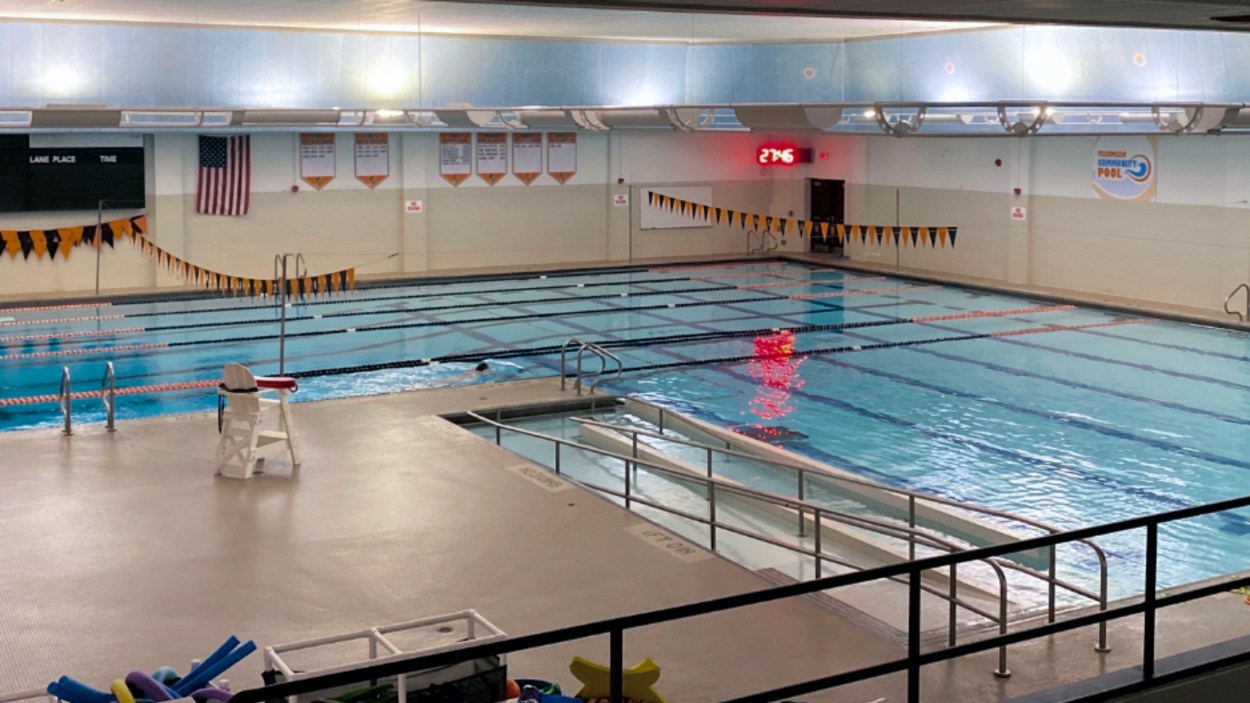
During the Monday, December 8, Tecumseh Public Schools board meeting, Aaron Phillips, a project manager at McCarthy & Smith construction, presented three potential options to board members for the Tecumseh Community Pool. At the previous meeting, board members learned that the steel columns in the pool’s wall areas suffered from corrosion and delamination and would necessitate a full replacement of certain sections.
You can watch the presentation and the following discussion from 0:32:30-1:08:55 in the video above, which I implore you to do and come to your own conclusions.
The three options presented were:
Option 1: Select Demolition and Rebuilding Existing Building — $15 Million
This plan would require demolishing the existing building and building a new one around the existing pool.
“The basic intent of this would be to demo all of the building and basically maintain just the pool basin,” said Phillips, adding that there are a lot of “caveats” and “unknowns that could go with that.”
He mentioned potential hazards, such as uncovering foundation issues, compatibility problems between new and existing portions of the building, and potentially damaging the pool basin, which could require significant work and costs.
“I think one thing that we all need to consider is we’ve been kind of doing an iterative inspection process,” said board member Lynne Davis. “That basin was also built in the late 80s and has not been fully inspected.”
Option 2: Demolish Pool and Cap Building — $1.7 Million + Soft Costs
This option would demolish the building and cap the school’s north wall, turning the area into new green space.
Option 3: Demolish Existing Pool and Build a New One — $28 Million
McCarthy & Smith presented the option of building a new 18,000-square-foot, eight-lane competition-size pool on a two-acre lot for an estimated cost of $28 million. That 18,000-square-foot number is just a placeholder. Pools being built in surrounding communities measure closer to 28,000 square feet, according to TPS’s director of operations, Josh Mattison. He clarified:
“That is not the set specifications for this; this is just for discussion purposes. If we decide this is an option, and put out RFPs [request for proposals], you might decide 28,000 square feet, like a similar pool in our neighboring communities are building, and those numbers then go up accordingly. These are very raw numbers to talk about basic pool construction, basic lot size—this is not quoted amounts, these are absolutely just for discussion based on square footage.”
After the presentation, board members discussed their next steps.
“Two of these options are not feasible without another financing option,” said board member Davis, who questioned what would need to happen to maintain the building’s safety if the district chose option 1 or 3.
Mathison said he’d have to ask the engineers, reminding the members “that we are in year three of the two-to-three years when that roof needs to come off there.”
“My opinion is that we need to understand that to make a decision that has the right information to the community about whatever decision we decide,” Davis added.
Board member Heather McGee said the district should “quickly and expeditiously obtain community input on this in various forms,” with board member Jacob Martinez agreeing.
“I think this comes back to the point we’ve talked about before that this is a community pool and it’s going take community buy-in to pay for it,” he said. “These are not get-creative levels of money, right? We can’t creatively come up with $28 million. So, this is going to require going back to the community and asking them to vote the money to do what they want done with the pool.”
Davis raised the possibility of the Michigan Association of School Boards (MASB) assisting the schools in collecting community input as part of the district’s upcoming strategic planning project, while also raising concerns about the roof’s structural integrity.
“I think the cost of a new pool requires full community support, and if we don’t get the community support, if we put it out there, and we don’t get it, then as a board we need to make decisions very quickly because this building is degrading every single day—every single snow fall this building is degrading,” she said.
Martinez expressed concern that waiting for the Michigan Association of School Boards could take too long. He said the district needs to quickly determine what the community will support because “we’re to the far end of the window of safety on that building, and you know we could find ourselves in a situation where we’re adding to cost because a roof collapsed or there’s some other issue that comes up.”
TPS Superintendent Matt Hilton said earlier in the meeting that he would provide answers to the members’ questions and plan for additional board discussion of the proposed options. Hilton added that he’d then direct Mattison to seek RFPs “depending on where the board lands” on what to do with the pool.
He also acknowledged that this “would be a major community engagement effort” for the district as it collects citizen input.
TPS voters approved a $7.5 million sinking fund in the November 2024 election, with the district receiving $1.5 million a year over the next five years. The district had allocated $2.5 million to the pool’s roof repairs. However, further inspections uncovered additional structural weaknesses, leading to the three proposed options.
The next TPS board meeting is scheduled for Monday, January 12, 2026, at the Tecumseh High School media center at 6 PM.
To read a complete summary of the December 8 TPS board meeting, visit Educate Tecumseh.

