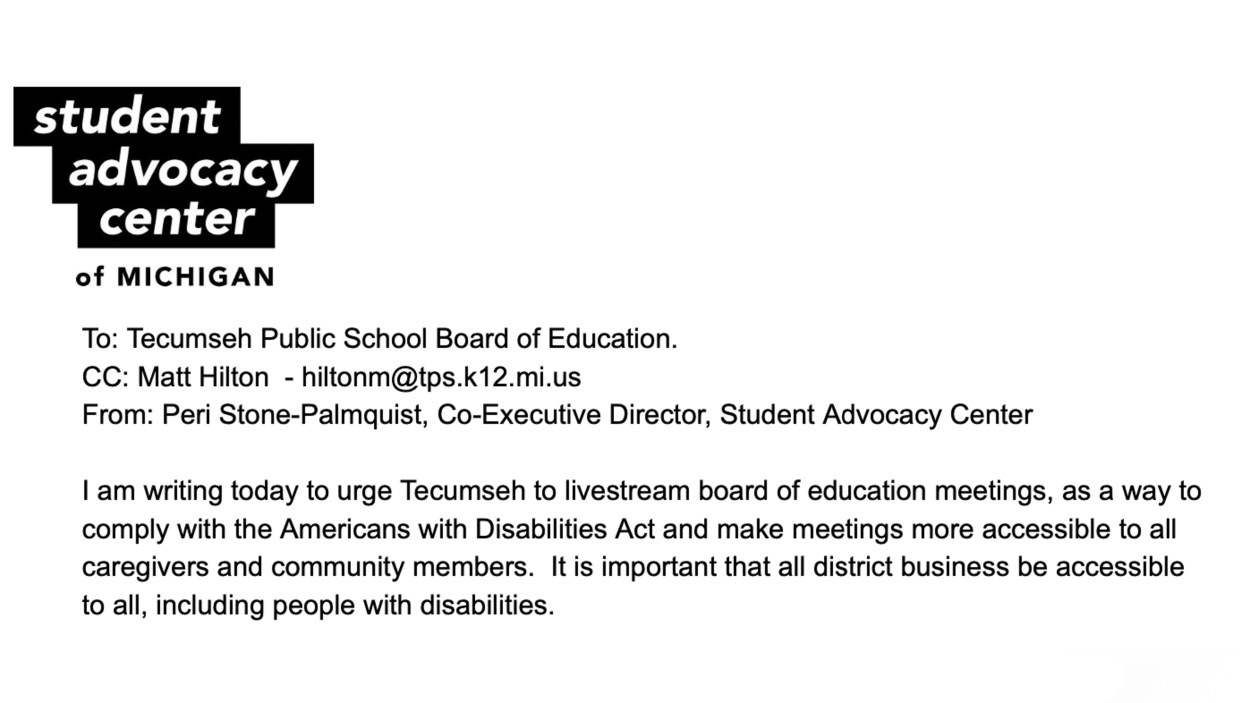
On October 24, 2024, Tecumseh Public Schools (TPS) board member Tim Simpson made a post on his candidacy Facebook page about livestreaming school board meetings. He said, in part, “It would be very costly for the school district to make sure the video streaming is compliant with the ADA (Americans with Disabilities Act).”
The Student Advocacy Center of Michigan (SAC), serving underserved families and students, sent a letter to TPS Superintendent Matt Hilton on November 1 after learning of Simpson’s comment.
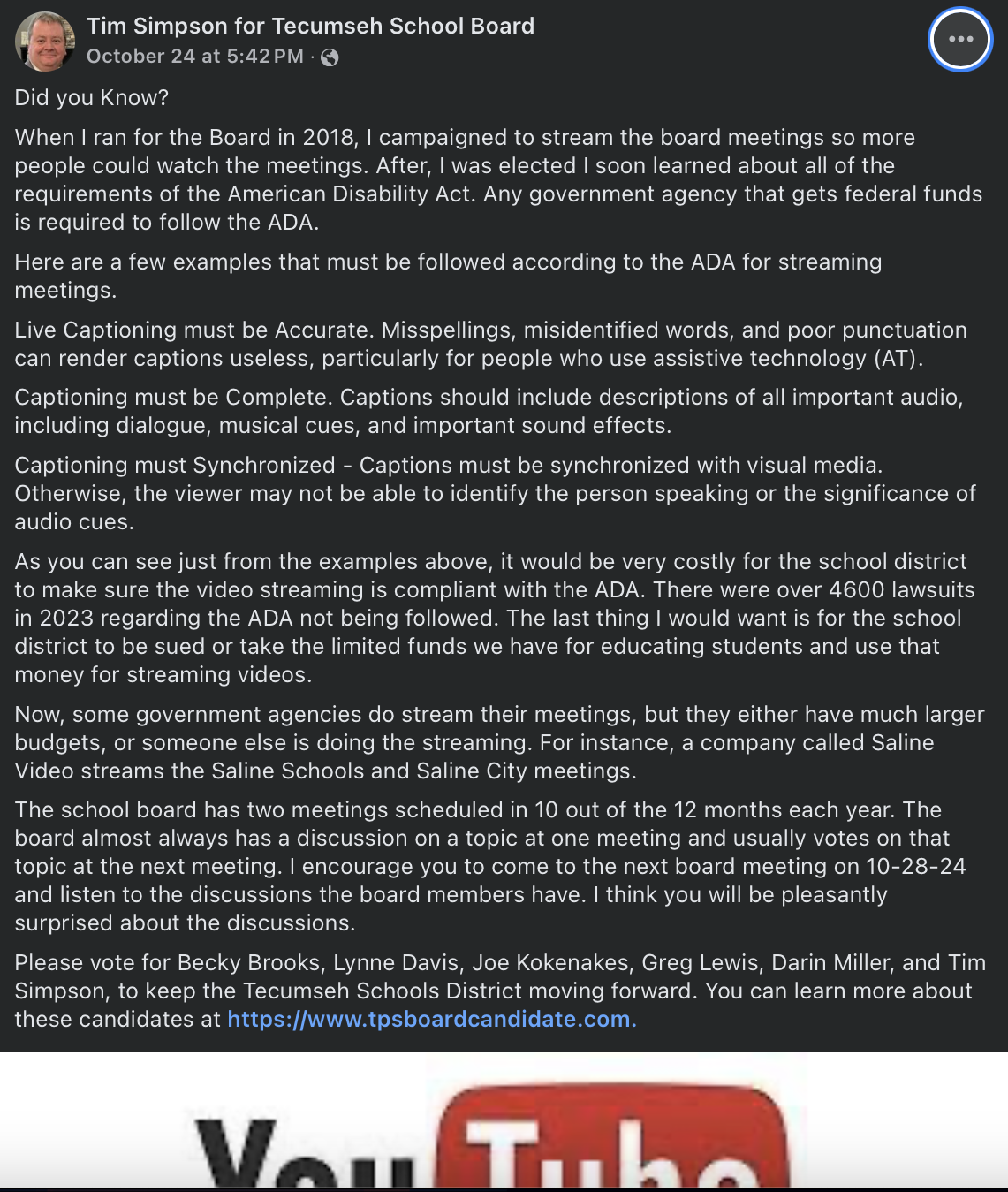
Peri Stone-Palmquist, Co-Executive Director, SAC wrote to Hilton asking Simpson to retract his public statement:
“Recently, it came to our attention that a current board member made a public statement alleging that livestreaming board meetings could potentially put the district in violation of the ADA and open the district to lawsuits and therefore was not possible.
“SAC checked with a disability rights organization and our own team members, who do extensive work on ADA. We believe this statement couldn’t be further from the truth. We believe Tecumseh schools is putting itself at risk of ADA non-compliance by not livestreaming its meetings, a best practice that increasingly more public bodies are offering.
“The Tecumseh School Board should rethink their stance on this issue and ask the board member to retract his public statement.”
The post was still up as of the November 11 TPS board meeting, during which livestreaming was a discussion item.
You can read SAC’s full letter here:
Simpson’s comment, in full, reads:
“Did you know?
“When I ran for the Board in 2018, I campaigned to stream the board meetings so more people could watch the meetings. After, I was elected I soon learned about all of the requirements of the American Disability Act. Any government agency that gets federal funds is required to follow the ADA.
“Here are a few examples that must be followed according to the ADA for streaming meetings.
“Live Captioning must be Accurate. Misspellings, misidentified words, and poor punctuation can render captions useless, particularly for people who use assistive technology (AT).
“Captioning must be Complete. Captions should include descriptions of all important audio, including dialogue, musical cues, and important sound effects.
“Captioning must Synchronized – Captions must be synchronized with visual media. Otherwise, the viewer may not be able to identify the person speaking or the significance of audio cues.
“As you can see just from the examples above, it would be very costly for the school district to make sure the video streaming is compliant with the ADA. There were over 4600 lawsuits in 2023 regarding the ADA not being followed. The last thing I would want is for the school district to be sued or take the limited funds we have for educating students and use that money for streaming videos.
“Now, some government agencies do stream their meetings, but they either have much larger budgets, or someone else is doing the streaming. For instance, a company called Saline Video streams the Saline Schools and Saline City meetings.
“The school board has two meetings scheduled in 10 out of the 12 months each year. The board almost always has a discussion on a topic at one meeting and usually votes on that topic at the next meeting. I encourage you to come to the next board meeting on 10-28-24 and listen to the discussions the board members have. I think you will be pleasantly surprised about the discussions.”

